> For the complete documentation index, see [llms.txt](https://docs.fylr.io/llms.txt). Markdown versions of documentation pages are available by appending `.md` to page URLs; this page is available as [Markdown](https://docs.fylr.io/help/tutorials/for-administrators/search-text-in-images-or-office-files.md).
# Search in Text of Images or Office Files
How to setup up fylr to use Optical Character Recognition (OCR) to write the human-readable content of a pixel-based file into the index, thus making in searchable.
{% hint style="warning" %}
Large files / large amount of files may temporarily slow down your instance due to increased processing requirements.
Some OCR jobs may fail to produce correct output because of source quality (fonts, external artifacts, DPI).
Special characters, pages structures and editorial features (tables, headers, footnotes etc.) are not filtered and may produce nonsensical contents.
{% endhint %}
By default, OCR is disabled for all files. This tutorial will expand on adding file types.
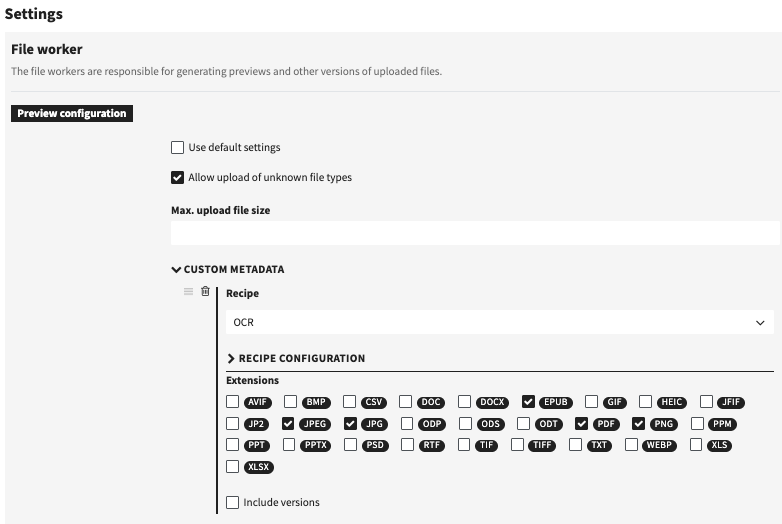
1. Navigate to [Base Configuration](/for-administrators/readme.md), into the [File Worker](/for-administrators/readme/file-worker.md)
2. Uncheck "Use Default Settings"
3. Expand "CUSTOM METADATA"
4. Add the extensions you want OCR applied to and written to the index
Example configuration of OCR to include JP(E)G, PNG, EPUB, PDF
The recipe configuration offers more options, those are not necessarily required to run OCR on new files.
### Verify OCR is Working
* Create a new record using the plus-icon
* As soon as you save, the OCR is beginning
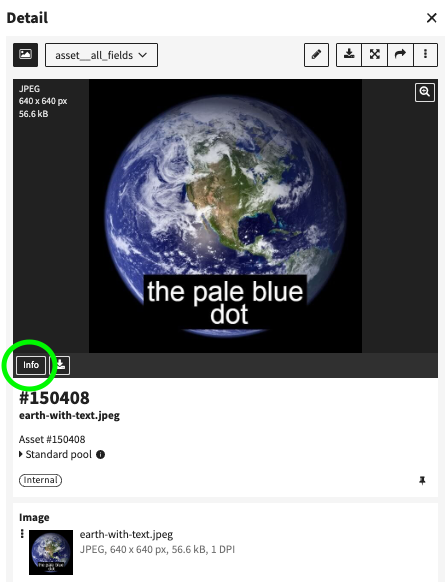
* Locate the newly created record and open in detail view
fylr detail view of example record
* Use the "Info" button to access the data available in index
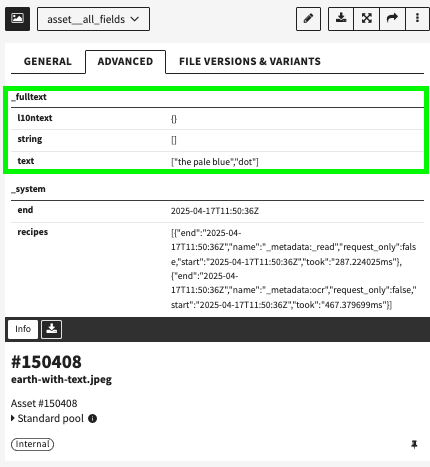
* In the "Advanced" tab, you will find the indexed content of the file under "\_fulltext"
Info section of a fylr record displaying the indexed OCR output
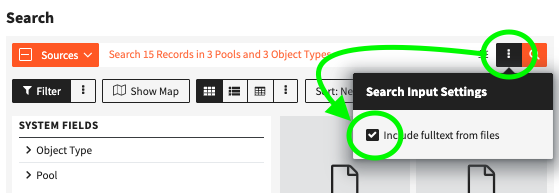
To search for the extracted content, make sure that the OCR-recognizable text of your files is included in the search result by activating the checkbox in the 3-dot menu on the far right of the search bar.
Now you can find records by searching the human readable content of files - just type in the search bar as usual.
{% hint style="info" %}
From fylr **6.34.0**, a file's extracted content (OCR text and embedded file metadata) is added to the searchable full-text index only when the **file field** has its **expert** search enabled in the mask. If the extracted text of a file cannot be found in search, check that the file field's expert search is turned on — and re-index existing records after changing it.
{% endhint %}
### Applying OCR on Already Existing Records
OCR image-to-text will run when indexing a file. Consult [Regenerating preview images](/help/tutorials/for-system-administrators/regenerating-preview-images.md) for a tutorial on how to reindex one or more existing records.
{% hint style="info" %}
From fylr **6.35.0** OCR reads **every page of a multi-page TIFF**; before, only the first page was read whenever the scan was larger than the recipe's `ocr` size (2000 by default), which a 300 dpi A4 page always is. Files scanned before the update keep the text they have — re-run the OCR recipe on them to pick up the remaining pages.
{% endhint %}